



Is waterjet cutting really slow? Facts that change the way we look at waterjet cutting.
Is waterjet cutting really slow? This is one of the most common myths about waterjet technology. In reality, cutting speed depends not on the machine itself, but on the proper selection of process parameters, the required edge quality, and the machine’s configuration. Modern CNC waterjet cutting machines allow for a precise balance between productivity, accuracy, and production costs. In this article, we explain what determines waterjet cutting speed, which parameters have the greatest impact on process efficiency, and why a well-configured waterjet cutter can be both extremely precise and surprisingly efficient.
Table of Contents
Waterjet Cutting—A Technology That Combines Precision and Efficiency
Why Is Waterjet Cutting Said to Be Slow?
5 levels of waterjet cutting quality—from the highest precision to high-speed cutting
What parameters determine waterjet cutting speed?
Water pressure and high-pressure pump—the energy behind the waterjet process
Nozzle diameter and waterjet cutting head—impact on accuracy and efficiency
CNC waterjet machines—CNC technology in modern manufacturing
Waterjet cutting machines—selecting the right equipment for the application
Applications of waterjet cutting—from metals to non-metallic materials
Optimizing the waterjet process based on research and technical literature
Summary—waterjet doesn’t have to be slow
Waterjet cutting—a technology that combines precision and efficiency
Is waterjet cutting slow? This is one of the most frequently asked questions about waterjet cutting technology. For years, this method has been associated primarily with very high quality, but also with the belief that precision always means long processing times and high costs.
In reality, modern waterjet systems demonstrate a completely different approach. Waterjet cutting doesn’t have to be slow—it just needs to be properly planned. The time required to produce a part is determined primarily by the process parameters, the proper selection of cut quality, and the machine configuration.
Modern CNC waterjet machines allow the user to decide whether the priority is the highest edge quality, maximum cutting accuracy, or fast and economical material separation. As a result, waterjet technology is used both in the production of precision components and in the industrial cutting of large quantities of parts.
The most important question, therefore, is not “Is waterjet cutting slow?” but “How do you select the waterjet cutting parameters to achieve the best results with optimal production time and cost?”
Why is it said that waterjet cutting is slow?
Waterjet cutting technology uses a very thin, concentrated stream of water under high pressure. The kinetic energy of the water allows material to be removed without the use of high temperatures, so the process does not create a heat-affected zone.
For soft materials, pure water cutting. This method works well for plastics, foams, rubber, and certain insulation materials, among others. Abrasive cutting, on the other hand, is used for processing metals and hard materials. In this process, an abrasive—most commonly garnet—is added to the water jet to increase the efficiency of material removal.
The high precision of this method stems from the nature of the process. To achieve the highest surface quality, the cutting head must move more slowly, allowing the water jet to interact more precisely with the material. This results in:
-
high-quality cutting,
-
lower surface roughness,
-
reduced edge taper,
-
high dimensional repeatability.
However, this does not mean that every application requires the highest quality. If the part will later be welded, ground, or subjected to further processing, a faster process setup may be more cost-effective.
5 levels of waterjet cutting quality—from the highest precision to high-speed cutting
One of the greatest advantages of waterjet technology is the ability to choose the quality standard. Professional systems allow for operation at five quality levels—from Q1, representing the highest accuracy, to Q5, where speed and efficiency in cutting the material are paramount.
The highest quality level, Q1 is used for components requiring maximum accuracy. Slower operation results in a very smooth surface, minimal need for further processing, and high dimensional precision.
Q2 and Q3 are the most commonly chosen industrial standards. They combine high cut quality with good process efficiency. They are often used in mass production, where a balance between turnaround time and cost is important.
The Q4 and Q5 levels are designed for high-speed cutting. They are used when the primary goal is to cut through the material rather than achieve a perfect surface finish. These settings work well for structural components, semi-finished products, and parts intended for further processing.
In waterjet technology, the best solution does not always mean the highest quality. The best solution is the one that meets the actual production requirements.
What parameters determine the waterjet cutting speed?
Waterjet cutting speed is not a fixed value assigned to the machine. It is the result of properly selecting a number of parameters, such as:
-
material type,
-
the thickness of the material to be cut,
-
the required quality level,
-
water pressure,
-
nozzle diameter,
-
amount of abrasive,
-
part geometry.
Proper selection of parameters allows for increased cutting efficiency without unnecessarily increasing costs.
Water pressure and the high-pressure pump—the energy source for the waterjet process
At the heart of every system is a high-pressure pump, which is responsible for generating the energy needed to power the waterjet. Modern, high-performance high-pressure pumps typically operate in the range from approximately 3,000 to over 6,000 bar. Higher pressure increases the jet’s energy and allows for more effective machining of harder materials. However, simply increasing the pressure does not always mean greater cost-effectiveness. Process efficiency depends on the interaction of all system components: the pump, the cutting head, the nozzle, and the control parameters.
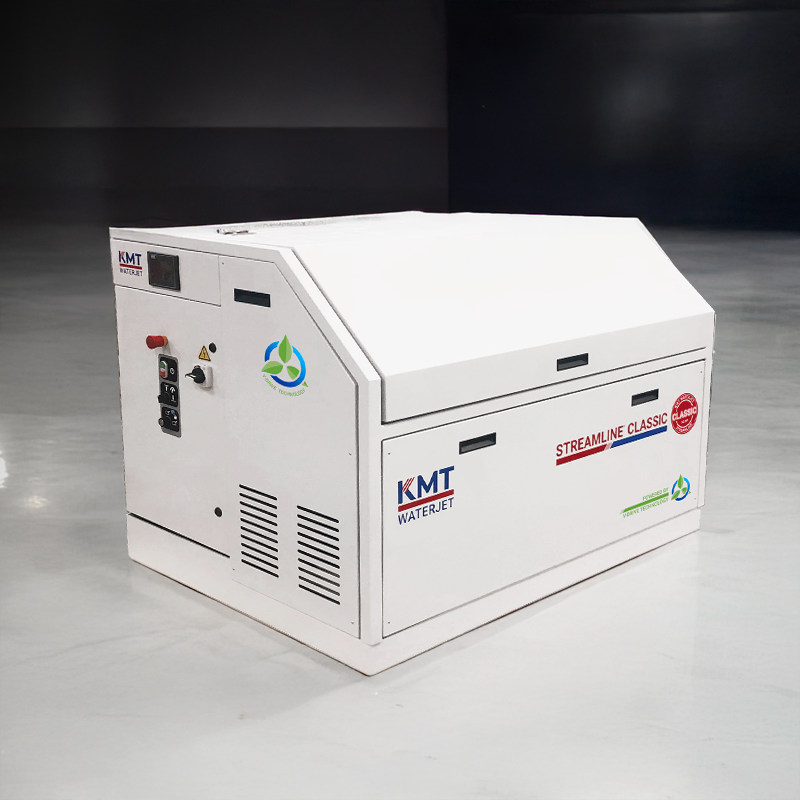
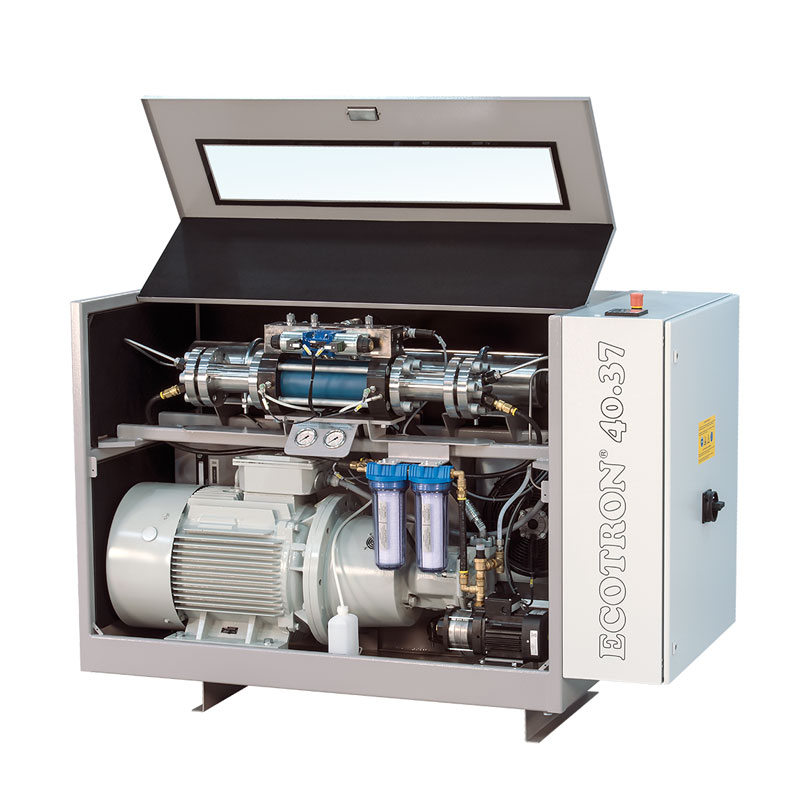
Popular manufacturers of high-pressure waterjet pumps
There are several proven brands of pumps for CNC waterjet machines on the market. The most common ones include:
- KMT Waterjet – one of the most popular manufacturers of waterjet pumps, offering solutions in the range of approximately 3,800–6,200 bar.
- BFT – a German manufacturer of high-pressure pumps, known for its Servotron and Ecotron series.
- Hammelmann – premium solutions for demanding industrial applications.
- Flow – a pioneer in waterjet technology and a provider of complete cutting systems.
- OMAX – manufacturer of waterjet machines using proprietary technology.
- ThyssenKrupp UHDE – high-performance pumps for industrial waterjet cutting systems.
- Resato – a manufacturer of high-pressure technologies for industry.
In practice, the most common configurations of industrial waterjet machines are based on pumps from KMT, BFT, and Hammelmann pumps, selected based on the required capacity, material type, and workload.
Nozzle diameter and waterjet cutting head—impact on accuracy and performance
The waterjet cutting head is responsible for precisely directing energy onto the material. Its design and the nozzle used have a direct impact on the quality and speed of the process. A smaller nozzle diameter produces a narrower water jet and greater precision. It is used where precise cutting of materials is required. A larger diameter increases the amount of energy transferred to the material, which improves efficiency when cutting thicker components. The right choice of cutting head—such as a 3-axis or 5-axis cutting head—allows the technology to be tailored to the specific production needs.
Amount of Abrasive in Abrasive Cutting—How to Optimize Costs?
In abrasive cutting, the amount of abrasive used is of great importance. An automatic abrasive feeding system ensures stable operation and control of operating costs. Too little abrasive can reduce the process’s effectiveness, while too much increases costs without a significant increase in speed. Optimization therefore involves finding the point at which the water jet provides the best balance of quality, speed, and cost.
Feed Rate and High Cutting Precision
The head feed rate is one of the most important parameters affecting the final result. A faster pass reduces production time but can result in greater surface roughness and poorer edge quality. Slower settings, on the other hand, ensure higher accuracy. That is why modern cutting systems allow parameters to be selected individually for each component.
CNC waterjet machines—CNC technology in modern manufacturing
Modern CNC waterjet machines enable full process control. Automatic control allows you to optimize the cutting path, reduce waste, and increase repeatability.
A professional waterjet cutting machine can be equipped with:
-
3-axis cutting heads,
-
5-axis cutting heads,
-
a laser sensor,
-
automatic abrasive feeding systems,
-
a tank—known as a cutting table.
CNC technology and cutting machine programming are also key elements. Systems such as Igems and Finest Cut enable the creation of efficient machining programs for both single-piece and batch production.
Waterjet cutting machine / waterjet cutter—selecting the right machine for the application
The choice of the appropriate machine depends primarily on the type of production, materials, and required accuracy.
A professional waterjet cutter can handle both precision parts and high-speed industrial cutting. The following factors are of key importance:
-
table working range,
-
pump power,
-
head configuration,
-
control system,
-
quality requirements.
Waterjet Cutting Applications—From Metals to Non-Metallic Materials
Waterjet technology enables the cutting of various materials and is used in many industries.
Machining aluminum, titanium, copper, brass, and bronze is standard practice in many industrial facilities. The technology is equally effective for machining granite, marble, stone, glass, porcelain, ceramics, and quartz. Waterjet is also used for processing composites, acrylic, plexiglass, plastics, soft materials, and wood.
As a result, waterjet cutting is used in the automotive industry, aerospace, the defense industry, mechanical engineering, and mass production.
Optimization of the waterjet process based on research and technical literature
Issues related to waterjet technology are extensively described in the literature on Abrasive Water Jet Machining (AWJ). Publications by A.W. Momber and R. Kovacevic, “Principles of Abrasive Water Jet Machining,” and research by M. Hashish on modeling the abrasive waterjet cutting process indicate that the process’s effectiveness depends on the interdependence of its parameters.
Research shows that increasing the cutting speed shortens the process time but may affect surface quality. Conversely, increasing the amount of abrasive improves efficiency only up to a certain level. The best results are achieved by carefully adjusting the parameters to the specific application.
Summary - Waterjet Doesn’t Have to Be Slow
Waterjet cutting is not a slow technology. It is a flexible technology that allows you to control quality, time, and production costs. Proper selection of the quality class (Q1–Q5), water pressure, nozzle diameter, abrasive quantity, and feed rate allows you to achieve exactly the desired result.
Source: Momber A. W., Kovacevic R., Principles of Abrasive Water Jet Machining, Springer, 1998; Hashish M., Research on Modeling the Abrasive Water Jet Machining (AWJ) Process, ASME Journal of Engineering Materials and Technology, 1984, 1989.
What is waterjet cutting?
What is waterjet cutting?
Waterjet cutting is a cutting process in which a high-pressure water jet is used to precisely cut various materials. For harder materials, an abrasive is added to the water jet to increase the cutting ability.
Why should you choose waterjet cutting?
Why should you choose waterjet cutting?
Waterjet cutting offers precision, flexibility and environmental friendliness. It is particularly suitable for heat-sensitive materials as it cuts without heat stress and produces no harmful gases or vapors.
Is waterjet cutting economically advantageous?
Is waterjet cutting economically advantageous?
Waterjet cutting can be considered economical as it minimizes material waste and enables precise cuts. The technology reduces production time and therefore lowers running costs, resulting in overall cost savings.